If you’ve ever bought a textile product and seen a small label with an arc over the words “Confidence in Textiles,” you’ve met OEKO-TEX®. It’s one of the most widely trusted safety marks in the textile industry — yet very few buyers actually know what’s behind it, what it tests for, or how to prove a label is genuine.
This guide breaks the whole system down, with the numbers and product classes that actually matter when you’re sourcing. Whether you’re buying microfiber cloths, wet wipes, mop pads, or any fabric that touches skin, here’s what OEKO-TEX® really means.
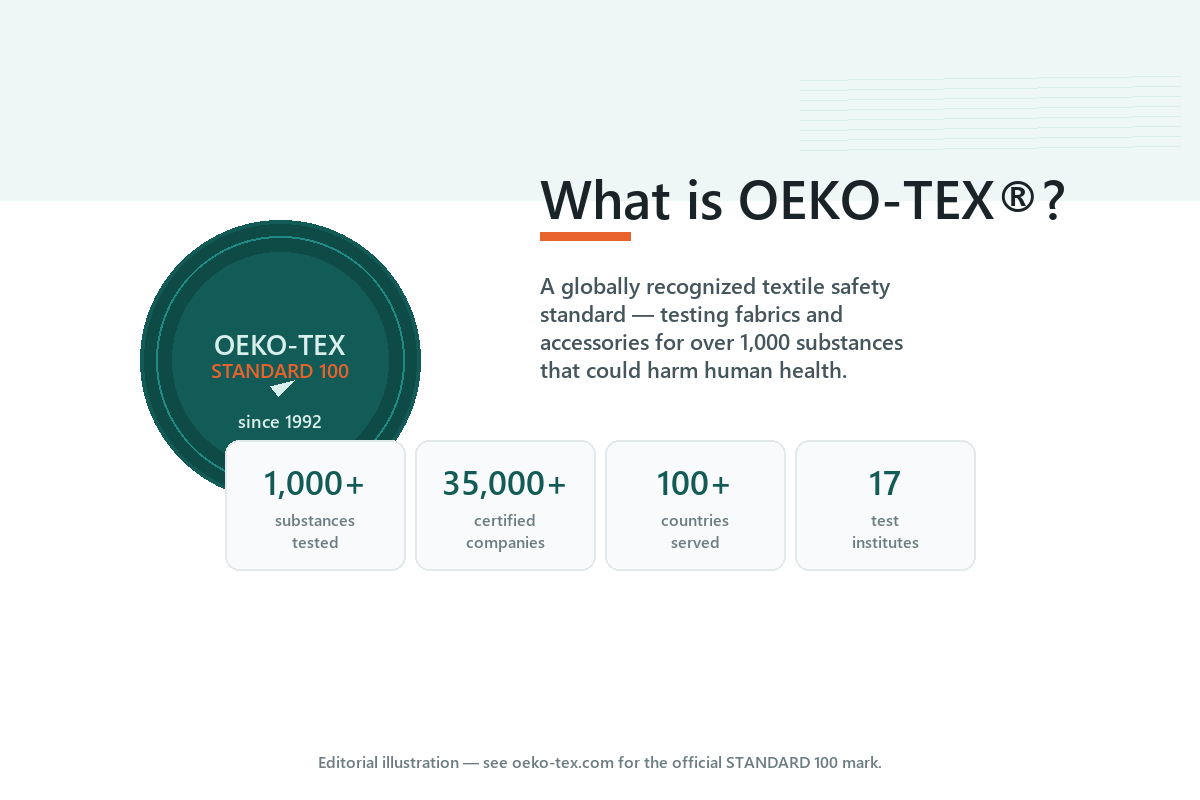
What OEKO-TEX® is in one line
OEKO-TEX® STANDARD 100 is a label for textiles tested for harmful substances. Every article carrying the label has been independently tested in an accredited laboratory and found to be free of — or within safe limits for — a long list of chemicals that could harm human health.
Crucially, it covers the whole product, not just the fabric. Every thread, zipper, button, print, and accessory is screened. If just one component fails, the whole article fails.
- The certified article is harmless to human health when used as intended
- Each component is tested against a list of over 1,000 harmful substances
- Limit values are reviewed at least once a year to keep pace with new science
- Test criteria are standardized globally, using the same methods worldwide
Why buyers should care
For a sourcing professional, OEKO-TEX® is both a risk-management tool and a sales tool:
- Compliance — it aligns with the requirements of major regulations, including the REACH Annexes XVII and XIV (EU), the U.S. CPSIA, and the ECHA SVHC candidate list.
- Market access — many large European and international retailers and brands require OEKO-TEX® STANDARD 100 as a condition of purchase.
- Quality signal — a valid certificate tells your customer the supplier is audited and the chemistry is controlled, which de-risks the conversation before samples even arrive.
- Sourcing network — the association’s directory links over 35,000 certified companies across the textile and leather supply chain, making it easier to find vetted partners.
Who runs it, and how it started
OEKO-TEX® is not one company’s marketing label. It’s run by an international association of independent test and research institutes — the International Association for Research and Testing in the Field of Textile and Leather Ecology, headquartered in Zürich.
- Founded in March 1992 by the Austrian Textile Research Institute (now OETI) and the German Hohenstein Institute
- Testex (Switzerland) joined in 1993; more European and Asian institutes followed
- Today it counts 17 test institutes across Europe and Japan, with offices in more than 70 countries
Because the testing is done by accredited third-party labs rather than by the factory selling the product, the mark carries independent authority. That independence is exactly why so many buyers treat it as a default.
What gets tested
The substance list is the heart of the standard. It is organized into a series of regulated categories, each with its own limit values — and the limits are stricter the more the product touches the skin.
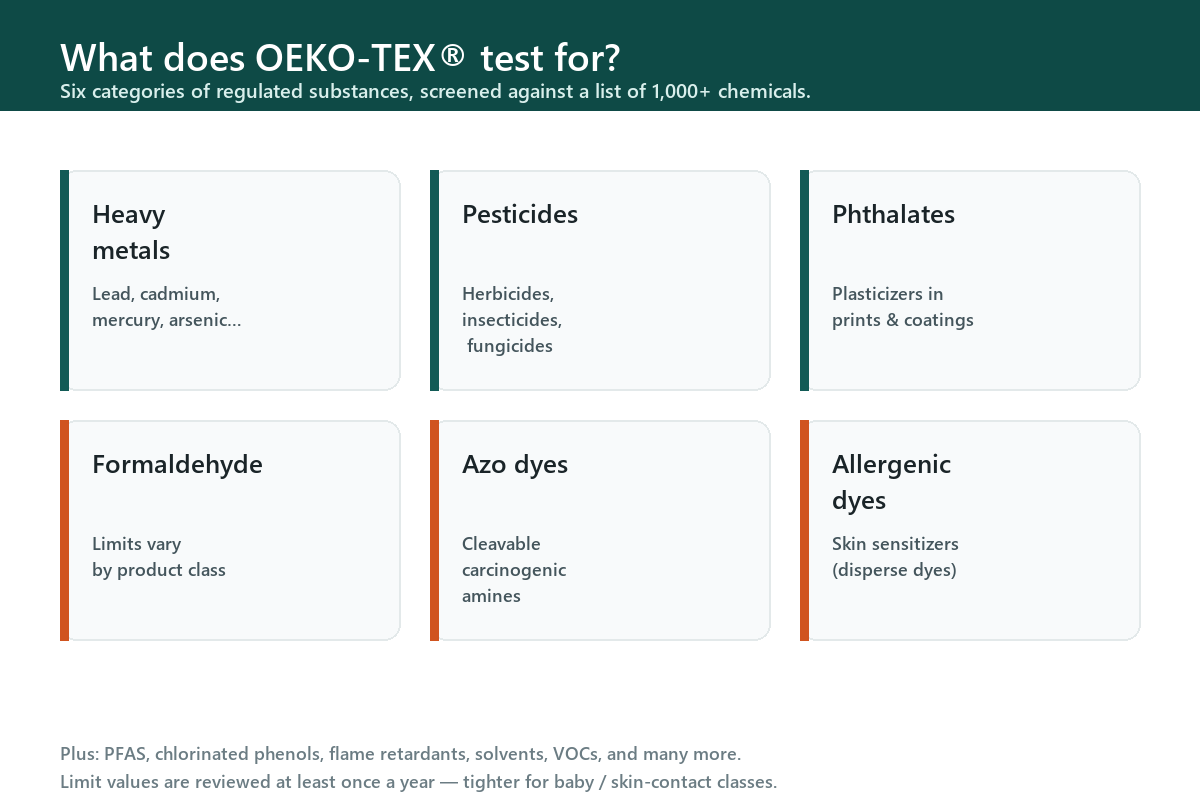
- Heavy metals — lead, cadmium, mercury, arsenic, and others
- Pesticides — herbicides, insecticides, fungicides
- Phthalates — plasticizers commonly found in prints, coatings, and soft-touch materials
- Formaldehyde — used in some resin finishes; limits vary by product class
- Azo dyes — those that can cleave into carcinogenic aromatic amines
- Allergenic dyes — dispersion dyes that are known skin sensitizers
Beyond these six headline categories, the list also covers PFAS, chlorinated phenols, flame retardants, solvents, and volatile organic compounds (VOCs). The full scope is far broader than a casual “safe to wear” promise — it’s a systematic audit of the entire chemistry of the product.
The 4 product classes
OEKO-TEX® doesn’t apply one blanket rule. It tailors the limit values to how the textile is used, because a baby’s romper and a curtain face very different exposure levels.
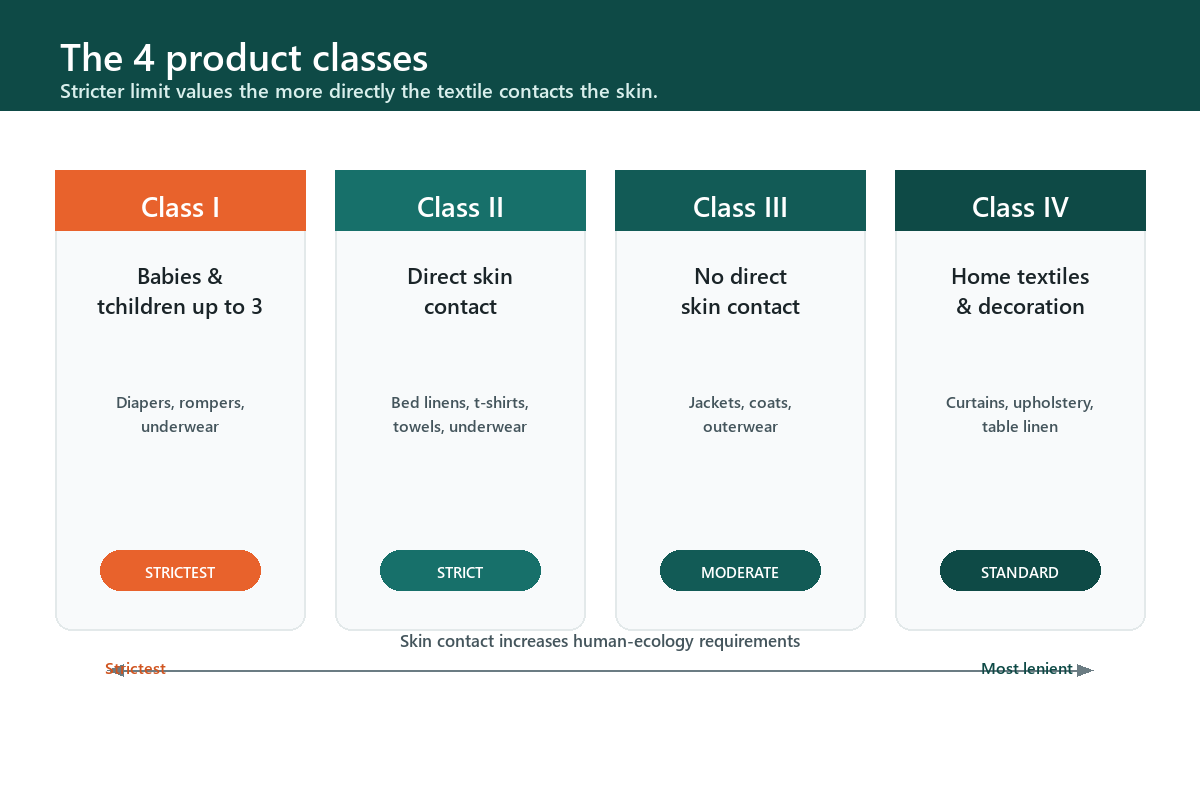
| Class | Contact | Typical products | Stringency |
|---|---|---|---|
| Class I | Babies & children up to 3 | Diapers, rompers, underwear | Strictest |
| Class II | Direct skin contact | Bed linens, t-shirts, towels, underwear | Strict |
| Class III | No direct skin contact | Jackets, coats, outerwear | Moderate |
| Class IV | Home textiles & decoration | Curtains, upholstery, table linen | Standard |
The rule of thumb: the more intensive the skin contact, the stricter the human-ecology requirements. If you’re sourcing a product that sits against skin — a microfiber body towel, a face wipe, or a cleaning cloth that touches hands constantly — you’ll want the certificate to state the correct class for that use.
STANDARD 100 vs the other OEKO-TEX® labels
“OEKO-TEX®” is an umbrella brand, not one certificate. Buyers frequently mix them up, so it’s worth a quick map:
- OEKO-TEX® STANDARD 100 — the product label for textiles tested for harmful substances. This is the one most people mean, and the most widely issued.
- OEKO-TEX® LEATHER STANDARD — the leather equivalent of STANDARD 100.
- OEKO-TEX® ORGANIC COTTON — confirms organic cotton content and safety, launched in 2023.
- OEKO-TEX® MADE IN GREEN — a product label that combines safety with evidence of environmentally friendly and socially responsible production, with a traceable product ID.
- OEKO-TEX® STeP — certification for production facilities (not products), covering environmental, social, and process sustainability. It’s a B2B label, not something you’d print on a hangtag.
- OEKO-TEX® ECO PASSPORT — a certificate for the chemicals and dyes used in textile processing.
- OEKO-TEX® RESPONSIBLE BUSINESS — a company-level certification.
Key point: a factory having STeP does not mean its products are STANDARD 100 certified, and vice versa. Always ask for the specific certificate that matches what you’re actually buying.
OEKO-TEX® vs GOTS: a common confusion
This is one of the most frequent questions, and the answer is simple:
- GOTS (Global Organic Textile Standard) certifies the organic content and the full processing chain of organic textiles — it’s primarily about what the fiber is and the chemistry used in production.
- OEKO-TEX® STANDARD 100 certifies safety from harmful substances — it’s about whether the finished item is harmless to health, regardless of whether the fiber is organic or conventional.
A product can be OEKO-TEX® certified without being organic, and it can be GOTS-certified without a STANDARD 100 label. They answer different questions. If a supplier says “organic and safe,” ask which certification covers each claim.
How certification works
The process is run by the accredited institutes and follows a defined path. It’s designed to be modular, so if all components are already certified, the finished-product testing cost can be reduced.
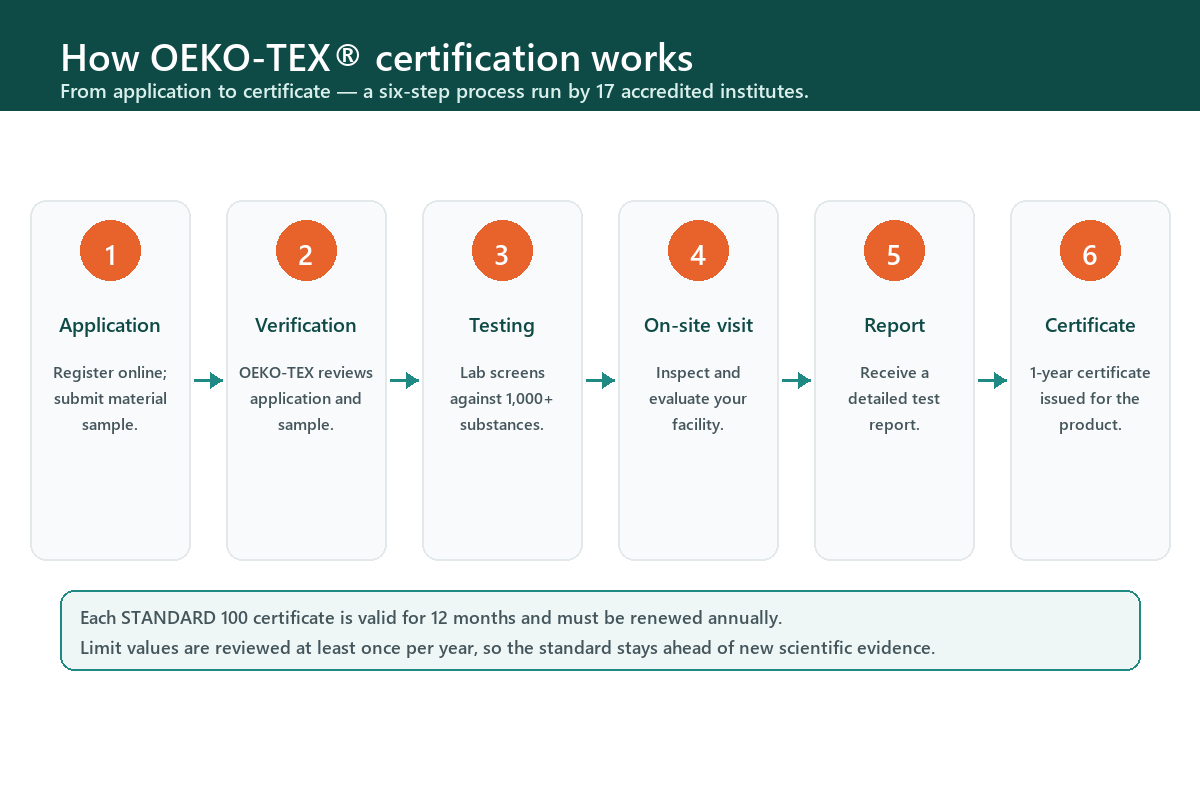
- Application — register online, complete the form, and submit a material sample
- Verification — the application and sample are checked
- Definition & analytics — test and measurement criteria are set, an individual measurement plan is built, and the sample is lab-tested against the 1,000+ substance list
- On-site visit — an inspector evaluates the company’s production facility
- Report — a detailed test report is delivered
- Certificate — a certificate is issued, typically valid for one year and renewable annually
The annual renewal matters. Because limit values are revisited at least once a year, a certificate from years ago is not evidence of current compliance. When you check a supplier, ask for a currently valid certificate — not a copy of an old one.
Why it matters for microfiber and cleaning products
If you’re in the cleaning-product business, OEKO-TEX® has direct relevance:
- Skin-contact risk is real. Microfiber cloths, wet wipes, body towels, and mop pads all come into repeated, often wet contact with skin. Any residual dye, finish, or chemistry left in the fabric is a potential concern.
- Wet wipes add water. Once a wipe is wetted, residues become more available — which is exactly why you should check the certificate class and the specific substances tested.
- It’s a trust signal for your brand. Put a valid, verifiable certificate on your packaging and you instantly differentiate from uncertified competitors.
- It de-risks imports. Requiring a STANDARD 100 certificate before you place an order is a low-cost way to avoid a costly batch failure at the dock.
How to verify an OEKO-TEX® label
Don’t trust a logo alone — verify the number. Every genuine STANDARD 100 label carries a certificate number and a reference to the issuing institute. OEKO-TEX® provides a public Label Check tool where you can enter the certificate number to confirm:
- It is currently valid (not expired)
- It belongs to the product and company you’re buying from
- It covers the right product class
If a supplier shows a label but refuses or can’t provide a matching valid certificate number, treat that as a red flag. It’s also a good reminder that the OEKO-TEX® logos are trademarks with strict usage rules — only licence holders with a valid certificate may display them.
FAQ
Q: Does OEKO-TEX® mean a product is organic? A: No. STANDARD 100 is about safety from harmful substances, not the fiber’s organic status. The two are separate.
Q: Does OEKO-TEX® test the whole product or just the fabric? A: The whole product — threads, buttons, zippers, prints, and accessories are all tested. If one component fails, the article fails.
Q: How long is a certificate valid? A: Typically 12 months. It must be renewed annually, and the limit values are reviewed at least once a year.
Q: Is OEKO-TEX® the same as GOTS? A: No. GOTS covers organic content and the organic processing chain; OEKO-TEX® STANDARD 100 covers safety from harmful substances. They answer different questions.
Q: Should I require OEKO-TEX® for cleaning products? A: For anything that contacts skin — towels, cloths, wipes — it’s a strong, low-cost quality signal and market-access requirement in many regions. Ask for a currently valid certificate with the correct product class.
The honest advice for buyers
OEKO-TEX® is not a magic guarantee — it’s evidence that a product’s chemistry has been independently checked against a science-driven, regularly updated standard. Used correctly, it’s one of the most practical tools a cleaning-product buyer has for de-risking a supply chain and proving safety to your own customers.
The next time you’re evaluating a cloth, wipe, or towel, ask two questions: Which OEKO-TEX® standard is it, and what’s the valid certificate number? Then check it — it takes thirty seconds and tells you a lot about how serious the supplier is.
Sourcing textiles that need to be safe on skin? Send us your product spec and target market — we’ll recommend the right fabric and grade, and we’re happy to walk you through certification options.